Health Research Digest with Leo and Eva
Cutting through the complexity of health and fitness research, Leo & Eva brings you the latest scientific discoveries—decoded for everyday life. We break down cutting-edge studies from the world’s top universities, making them easy to understand and apply. No jargon, no fluff—just real science, simplified. 🎙️ New episodes weekly! 📖 Read more on the ORIEMS FIT Research Digest: https://oriems.fit/blogs/research-digest/ Subscribe now for evidence-based insights that actually matter! 🚀




Episodes

Feb 24, 2026
Feb 24, 2026
15 min
Can EMS really make your muscles stronger?Or is it just a strange buzzing feeling?
Maybe your legs feel weaker lately.Maybe your back tires easily.Maybe you train hard but still feel one side lagging.You want something extra.But you also want real evidence.
A 2023 systematic review in the Journal of Strength and Conditioning Research looked at this question.Researchers from universities in Australia, Singapore, and Europe analyzed 10 controlled studies.
Here’s what they found.
EMS was associated with improvements in measured muscle strength in healthy adults.Strength tests showed a measured increase in force output.This included both younger and older participants.
However, sprinting and jumping did not consistently improve.So it helped strength tests.But not automatically performance.
Why does that matter?
Because stronger muscles can support daily tasks.Standing from a chair.Climbing stairs.Holding posture longer.
It suggests EMS can stimulate muscles in a measurable way.But it is not magic.And it does not replace movement practice.
The review included randomized and controlled trials.It was peer-reviewed and published in a respected strength journal.
If you are considering EMS, this gives realistic reassurance.If you already use EMS, consistency may matter more than intensity.
There are more details in the full breakdown.
Read the full breakdown here → https://bit.ly/4aT8pyP
Educational content only. Not medical advice.

Feb 23, 2026
Feb 23, 2026
15 min
Can strength improve without lifting heavier?What if strong contractions matter more than you think?
Maybe you train hard.But one side still feels weaker.Or pain limits how much weight you can use.Or your muscle just does not “fire” the way it used to.
That feeling is frustrating.You are trying.But the muscle does not fully respond.
A 2023 review published in the Journal of Strength and Conditioning Research looked at what actually drives strength gains.The researchers included experts from Ohio University and U.S. Army research institutes.
They explained something important.
Strength improves when muscles experience strong, repeated contractions.That is one of the key stimuli.
The review noted that electrically evoked contractions, like those produced by EMS/NMES, have been associated with strength increases over time in research settings.
In simple terms:If a muscle contracts forcefully and repeatedly, it adapts.
EMS works by activating motor nerves directly.That creates muscle contraction, even when voluntary effort is limited.
The research did not say EMS replaces lifting.It did not claim dramatic shortcuts.It suggested EMS may support strength by reinforcing one core driver: forceful contraction.
For healthy people already lifting heavy, the extra benefit may be small.But in situations where heavy loading is limited, this mechanism may matter.
This review was peer-reviewed and based on multiple controlled studies.
Why does this matter in everyday life?
Because strength is not only about lifting more weight.It is also about how well your nervous system activates muscle.
If pain, injury, or weakness limits your training,supporting muscle activation may be meaningful.
It is not magic.It is physiology.
There is much more detail in the full article, including when EMS may help most and when it may add little.
Read the full breakdown here → https://bit.ly/46qiAJM
Educational content only. Not medical advice.

Feb 23, 2026
Feb 23, 2026
14 min
Your back still aches after sitting 20 minutes?What if improvement doesn’t start with bigger muscles?
You try to sit straight.You adjust your chair.You stretch.But the ache returns by afternoon.
Some days, it feels like your back is weaker than it should be.Or tired before the day is done.
A real randomized controlled trial from Concordia University looked at this.It was published in the Journal of Functional Morphology and Kinesiology.
Adults with chronic low back pain used EMS twice weekly for 10 weeks.
Here’s what they found.
MRI scans showed minimal deep muscle size change.But pain scores showed improvement over time.
Average pain dropped by about 2 points on a 0–10 scale.Disability scores showed improvement.Pain interference in daily life showed improvement.Pain catastrophizing showed improvement.
One EMS protocol was associated with stronger improvement in sitting pain.
So what does this mean?
It suggests EMS may help how pain feels.It may help how much pain disrupts your day.Even if deep muscle scans don’t dramatically change.
That matters if:Sitting feels exhausting.Driving feels uncomfortable.Your day feels limited by your back.
This does not promise muscle rebuilding.It does not promise a cure.But structured, consistent EMS was associated with measurable improvements.
The study was controlled and randomized.Participants were followed for 10 weeks.Results were peer-reviewed.
If you already use EMS, consistency matters.If you are considering it, expectations should be realistic.
There are more details about protocols and numbers in the full breakdown.
Read the full breakdown here → https://bit.ly/4qQTdIk
Educational content only. Not medical advice.

Feb 23, 2026
Feb 23, 2026
10 min
Can muscle weaken even when you’re resting?
And what if your body can’t exercise at all?
Maybe you’ve felt that heaviness.
After illness.
After surgery.
After days in bed.
Your legs feel smaller.
Standing feels harder.
Strength feels different.
A 2025 published clinical trial protocol from University Hospital Bonn in Germany, in the peer-reviewed journal Trials, is studying this exact problem.
They plan to enroll 120 ICU patients.
The study has 4 randomized groups.
One group receives structured electromyostimulation (EMS).
The EMS settings are specific:
• 50 Hz frequency
• 10 seconds on / 10 seconds off
• 400 microsecond pulse width
• Daily sessions for 7 days
Researchers will measure:
• Muscle mass
• ICU-acquired weakness rates
• Metabolic markers
• ICU length of stay
• Rehabilitation outcomes
This paper is a protocol.
Final results are not published yet.
But here is what matters.
Hospitals are seriously testing EMS.
Not as a shortcut.
But as a controlled muscle stimulus.
EMS creates measured muscle contractions.
Even when someone cannot move voluntarily.
Why does this matter for everyday life?
Because muscle can change faster than we think.
And activation matters.
For someone considering EMS:
Think of it as structured stimulation.
Not magic.
Not instant results.
For someone already using EMS:
Consistency matters.
Proper placement matters.
Realistic timelines matter.
This was designed as a randomized controlled trial.
It is peer-reviewed.
Ethics approved.
Carefully monitored.
That adds credibility.
The science is cautious.
But the investigation is serious.
If you want to understand how EMS works,
what realistic expectations look like,
and what this study means in practical terms,
There are more details in the full article.
Read the full breakdown here → https://bit.ly/4kSYrCf
Educational content only. Not medical advice.

Feb 23, 2026
Feb 23, 2026
21 min
Can EMS make your lift stronger?Or is it just another fitness trend?
Maybe you train hard every week.But one leg still feels weaker.Or your muscles fatigue faster than expected.Or pain makes you hold back effort.
You push the weight.But it feels like not all fibers join in.
A 2010 randomized controlled trial looked at this.Published in the Journal of Strength and Conditioning Research.Researchers in Spain compared lifting with EMS vs lifting alone.
Both groups trained the same way.Same weight.Same sets.Same frequency.
The only difference?One group received EMS during each repetition.
After four weeks, both groups improved.But the EMS group showed a larger measured increase in maximal strength.The difference was even clearer after a short recovery period.
Sprint speed did not clearly improve.Jump height did not clearly improve.
So what does this suggest?
EMS was associated with greater strength adaptation.It may increase neuromuscular recruitment during lifting.
That means more muscle fibers may be activated.Especially when programmed correctly.
But it did not automatically improve explosiveness.Strength and coordination are not the same thing.
Why does this matter for you?
If your goal is getting stronger,EMS may provide additional stimulus during resistance training.
If your goal is sprint speed or vertical jump,You still need power and technique work.
This was a controlled, randomized study.Young healthy men.Four weeks.Single movement pattern.
It does not promise results.It shows what was measured under specific conditions.
If you already use EMS,this may explain why strength feels more solid.
If you are considering EMS,it may be a supportive tool.Not a shortcut.
More details, data, and full breakdown are in the article.
Read the full breakdown here → https://bit.ly/40qFGMM
Educational content only. Not medical advice.

Feb 23, 2026
Feb 23, 2026
18 min
Already training hard but not seeing the change you expect?
Could something small make your effort work a little better?
Maybe you lift three times a week.
Maybe your legs feel strong but still soft.
Maybe your arms look the same month after month.
Or pain makes you hold back slightly.
You are not lazy.
You are already consistent.
A 2023 study published in PeerJ looked at this.
Researchers from National Taiwan Sport University studied healthy men and women for 8 weeks.
Both groups did resistance training.
One group added daily Electrical Muscle Stimulation (EMS).
Here’s what they observed.
The EMS group showed improvement in measured muscle mass.
They also showed improvement in measured body fat percentage compared to training alone.
Muscle mass increased by about 0.8 kg in the EMS group.
The training-only group slightly decreased.
Body fat percentage reduced in the EMS group.
It increased in the non-EMS group.
Grip strength also showed improvement.
This does not mean EMS replaces training.
Everyone in the study lifted weights.
It suggests EMS may add extra muscle activation.
Especially when layered onto structured training.
Why does this matter?
Because progress sometimes slows.
Even when effort stays high.
If a tool can provide additional stimulus,
that may help some people move forward again.
Not instantly.
Not magically.
But gradually.
Over weeks of consistent use.
The study was randomized and peer-reviewed.
Blood markers were also monitored for safety.
It focused on healthy young adults.
So results may not apply to everyone.
Still, it adds something important.
Evidence.
If you are considering EMS,
or already using it,
this research gives context.
There is more detail in the full breakdown.
Including protocol, frequency, and limitations.
Read the full breakdown here https://bit.ly/4aKHBAJ
Educational content only. Not medical advice.

Feb 22, 2026
Feb 22, 2026
16 min
Can adding EMS to your workouts make a real difference?
What if strength gains are not only about lifting heavier?
Maybe you train consistently.
But one leg still feels weaker.
Or your jump feels flat.
Or pain made you back off intensity.
You are doing the work.
But progress feels slower than expected.
A published study in the Journal of Strength & Conditioning Research looked at this.
Researchers at Baylor University studied trained female track athletes.
They compared weight training, EMS, and both combined.
After 6 weeks, the combined group showed improvement.
Strength increased more than lifting alone.
Vertical jump height also showed greater gains.
The differences were statistically significant.
EMS was associated with greater measured strength and power outcomes.
But only when paired with proper resistance training.
Why does this matter?
Because strength is not just muscle size.
It is also muscle activation.
It is how well your nervous system recruits fibers.
EMS creates additional muscle contractions.
That may increase neuromuscular stimulus during sessions.
Not a shortcut.
Not magic.
But possibly an added layer.
It does not replace good programming.
It does not replace effort or recovery.
It supports what you already do.
This was a controlled, randomized training study.
Short term.
Athlete population.
Measured outcomes only.
That means realistic expectations matter.
If you already train, EMS may be a tool.
Not a replacement.
Not a promise.
Just another way to stimulate muscle.
There are more details in the full article.
Including exactly how the training was structured.
Read the full breakdown here → 👉 https://bit.ly/4s9ea2o
Educational content only. Not medical advice.

Feb 22, 2026
Feb 22, 2026
19 min
Already training but still feel weak in some lifts?What if activation, not effort, is the missing piece?
You show up twice a week.You track your reps.You push hard.
But one side still feels slower.Your squat stalls.Your arms don’t respond like they should.
A 2019 published study in Clinics looked at this.Researchers from Brazil and the USA studied strength training with and without whole-body EMS.Healthy adults trained twice weekly for 8 weeks.
Both groups lifted the same program.Same sets. Same reps. Same rest.
One group wore EMS during training.
Here’s what they observed.
Both groups showed improvement in strength and muscle thickness.But the EMS group showed larger percentage gains in squat strength.They also measured greater increases in biceps muscle thickness.
The training did not change.The volume did not increase.The only added variable was stimulation.
The researchers suggested EMS may enhance muscle recruitment during exercise.It may increase mechanical and metabolic stress.Both are associated with adaptation.
This matters if you:
• Feel stuck despite consistent lifting• Want more activation per session• Struggle with muscle engagement after pain or inactivity
It does not replace proper training.It does not replace effort.It does not replace medical care.
But it may support activation when used correctly.
The study was randomized and controlled.Measurements included 1RM strength and ultrasound muscle thickness.
That gives the findings more credibility than anecdotal stories.
There’s more detail in the full breakdown, including limitations and realistic expectations.
Read the full breakdown here → https://bit.ly/4tXlW15
Educational content only. Not medical advice.
Feb 22, 2026
Feb 22, 2026
19 min
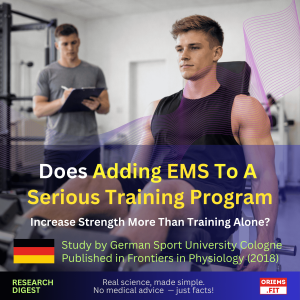
Can adding EMS to your training actually increase strength?Or is it just another fitness trend?
Maybe you train consistently.But one leg still feels weaker.Or your strength plateaus.Or pain limits how hard you push.
You start wondering if there is something missing.
In 2018, researchers from the German Sport University Cologne tested this.The study was published in Frontiers in Physiology.They looked at trained young men over 8 weeks.
Both groups did the same strength program.One group added Whole-Body EMS during exercises.
Here is what they found.
Both groups improved.Structured training works.
But the EMS group showed greater improvement in leg extension maximal strength.About +7.7% compared to +2.1% without EMS.
Most other measures were similar.
This suggests EMS may provide an additional strength stimulus.Especially for specific movements.When combined with proper training.
It did not replace hard work.It did not magically improve sprint speed.But it was associated with measurable strength changes.
Why does this matter?
Because if you already train seriously,you might not need something extreme.You may need something supportive.
EMS stimulates muscle contraction during movement.It can increase recruitment while you train.But recovery, programming, and consistency still matter.
This was a randomized controlled trial.That means groups were compared fairly.Results were peer-reviewed before publication.
There are more details in the full article.Including limitations and practical takeaways.
Read the full breakdown here → https://bit.ly/4b38f98
Educational content only. Not medical advice.

Feb 21, 2026
Feb 21, 2026
14 min
Are you training hard but the fat won’t move?
Could 25 minutes make a difference?
Maybe you lift twice a week.
Maybe your knees ache during squats.
Maybe your back feels tight after work.
And you still want your body fat lower.
A 2025 study in the Journal of Exercise Science & Fitness looked at this.
Researchers compared 25-minute EMS sessions with 90-minute resistance training.
The study lasted 20 weeks.
Participants trained twice per week.
Both groups reduced body fat.
The EMS group went from 25.9% to 20.5%.
That’s a measured reduction over time.
Strength also showed improvement across major exercises.
Traditional lifting reduced more fat overall.
But EMS still showed meaningful change.
And sessions were much shorter.
Why does this matter?
Not everyone can train heavy for 90 minutes.
Some people deal with joint pain.
Some feel muscle weakness after illness or injury.
Some are simply time-poor.
EMS activates multiple muscle groups together.
Muscle activation increases energy demand.
Over weeks, that was associated with reduced body fat.
It is not a shortcut.
It is not magic.
It does not replace disciplined training.
But it may add extra stimulus.
It may support your fat-loss phase.
It may help when heavy lifting isn’t possible.
The study was randomized and controlled.
Participants were followed for 20 weeks.
Results were peer-reviewed and published.
That gives the findings more weight.
If you care about body composition, this matters.
If you already use EMS, this may reassure you.
If you’re considering it, this gives context.
There are more details in the full breakdown.
Including strength data and comparison numbers.
Read the full breakdown here https://bit.ly/4aEXUyP