Health Research Digest with Leo and Eva
Cutting through the complexity of health and fitness research, Leo & Eva brings you the latest scientific discoveries—decoded for everyday life. We break down cutting-edge studies from the world’s top universities, making them easy to understand and apply. No jargon, no fluff—just real science, simplified. 🎙️ New episodes weekly! 📖 Read more on the ORIEMS FIT Research Digest: https://oriems.fit/blogs/research-digest/ Subscribe now for evidence-based insights that actually matter! 🚀




Episodes

Feb 4, 2026
Feb 4, 2026
33 min
What if your muscles could be activated without lifting a single weight?And what if that idea quietly shook hospitals, gyms, and rehab science?
A UK hospital study tested electrical muscle stimulation after serious hip fractures.It followed real patients aged over 65 after femur surgery.
The shock was not what people expected.The muscles did respond to electrical signals.
Some patients showed visible muscle contractions in just minutes.Others could feel strong muscle activation without moving at all.
Yet only 20% tolerated stimulation strong enough to fully move the leg.Pain, sensitivity, and frailty changed everything.
Why does this matter?Because muscles don’t just move bones.
Muscles control balance, walking speed, and independence.After hip fractures, 60% of older adults never walk the same again.
Electrical stimulation targets muscles directly.No treadmill.No dumbbells.No gym membership.
So why isn’t everyone talking about this?Because the story is not simple.
Hospitals learned something uncomfortable.Technology alone is not enough.
Dose matters.Comfort matters.Design matters.
This study exposed the limits.But limits reveal where breakthroughs come next.
Better electrodes.Smarter stimulation.Human-centred design.
That’s the part rarely discussed.And it threatens old models of rehab, pills, and endless memberships.
If muscles can be activated without movement,who really controls recovery?
This research opened questions many prefer ignored.And that’s why it matters.
Click the link to explore the full research digest.Find the original study, podcast discussion, and deeper discoveries.
👉 https://bit.ly/3MjvxOF

Feb 3, 2026
Feb 3, 2026
37 min
Scientists discover a simple daily electrical treatment that made fractured bones tougher, thicker — and harder to break
Broken bones are supposed to rest.
No movement.No stress.Just time.
But a jaw-dropping study has found that sending small electrical pulses to nearby muscles can make broken bones heal dramatically stronger — even when the bone itself doesn’t move at all.
The discovery has left researchers stunned.
In a controlled experiment, bones exposed to daily electrical muscle stimulation healed with up to DOUBLE the strength of untreated fractures.
The experiment that shocked bone experts
Researchers deliberately broke the leg bones of laboratory rabbits under strict conditions.
This wasn’t a random injury.
The bones were:
Cleanly cut
Held apart with a small gap
Locked in place with an external frame
In other words:A worst-case fracture scenario, designed to heal slowly.
Half the animals were then given a surprising treatment.
For one hour a day, gentle electrical pulses were sent into the muscles near the break.
The other half got nothing.
What happened next caught scientists off guard.
The results were impossible to ignore
After just eight weeks, the electrically stimulated bones showed explosive improvement.
Compared to untreated fractures, these bones had:
31% more bone mineral at the break
27% larger healing mass holding the bone together
62% higher breaking strength
29% more stiffness
34% greater bend before snapping
A staggering 124% increase in energy needed to break the bone
Put simply:
👉 These bones were far harder to break again.
One test showed they absorbed more than twice the force before failing.
And here’s the wild part…
The electricity never touched the bone.
It wasn’t zapping the fracture.
It was only causing nearby muscles to gently contract.
Yet the bone reacted as if it had received a powerful growth signal.
So how could this even work?
Scientists believe the answer lies in blood flow and natural body mechanics.
Electrical stimulation:
Makes muscles contract rhythmically
Acts like a natural pump, pushing blood through the limb
Delivers more oxygen and nutrients to the fracture site
May trigger biological signals that tell bone cells to rebuild faster
In short:
The muscles woke the bone up.
Even without walking.Even without loading weight.Even while the fracture stayed locked in place.
Not exercise. Not movement. Something else entirely
This wasn’t rehabilitation.
The animals were not running.They were not stressing the bone.They were not “working out.”
They were resting — while electricity quietly did the work.
That’s what makes the discovery so unsettling.
Why this finding turned heads
Electrical stimulation has been used for decades to:
Prevent muscle wasting
Reduce swelling
Maintain strength during immobilisation
But clear proof that it could supercharge bone healing was missing.
Until now.
This study didn’t just show faster healing.
It showed stronger, tougher bone — the kind doctors want to see after serious fractures.
What researchers were careful NOT to claim
Despite the shocking results, scientists stayed cautious.
They did not say:
This will work the same way in humans
It replaces surgery or casts
It guarantees faster recovery
They stressed:
The study was done on animals
Only one electrical setting was tested
Timing and dosage still matter
More research is needed before this enters hospitals.
Why the study matters
The research was published in the Journal of Orthopaedic Research, a respected peer-reviewed journal read by surgeons and scientists worldwide.
That means:
The data was scrutinised
The methods were challenged
The results were strong enough to publish
This wasn’t hype.
It was measured — and still shocking.
The takeaway that’s making experts pause
For generations, broken bones meant one thing:
Stay still and wait.
Now, this study raises a provocative question:
What if the body heals better when gently stimulated — even during rest?
Electricity didn’t just help muscles.
It may have quietly rewritten what we know about bone healing.
Disclaimer
This article is provided for general informational and educational purposes only.
It summarises findings from a peer-reviewed scientific animal study.The research was not conducted on humans, and the observations described cannot be assumed to apply to people.
This content does not constitute medical advice, clinical guidance, diagnosis, or treatment recommendations.
Electrical muscle stimulation (EMS / NMES) products referenced or implied in this article are not medical devices as defined by the Therapeutic Goods Administration (TGA) and are not intended to diagnose, treat, cure, or prevent any disease, injury, or medical condition.
No claims are made regarding:
fracture treatment
injury recovery
healing outcomes
clinical effectiveness in humans
Readers should not rely on this article to make health, injury, or rehabilitation decisions.
Always seek advice from a qualified healthcare professional registered in Australia before making decisions related to health, injury recovery, or medical care.
For full scientific context, limitations, and methodology, readers should consult the original peer-reviewed research publication directly.Full disclaimer: https://oriems.fit/blogs/research-digest/disclaimer

Jan 29, 2026
Jan 29, 2026
25 min
Most people think muscles weaken forever after 45.But what if that belief was never fully true?
What if a hidden scientific finding quietly challenged everything we were told?And what if very few people were meant to hear about it?
In 2024, scientists reviewed 9 clinical trials involving 335 adults aged 45–70.These people were not athletes.They were everyday adults.
Across those trials, 8 out of 9 showed stronger muscles after electrical stimulation.Strength was measured using real tests, not opinions.Chair stands.Force output.Objective data.
No extreme workouts were required.No gym contracts were signed.No pills were swallowed.
So why don’t more people know this?Because strong muscles without gyms change a big industry story.And big industries rarely like quiet alternatives.
Electrical muscle stimulation doesn’t replace exercise.But research suggests muscles still respond to signals later in life.Even when movement is limited.
That single idea changes how aging is viewed.It challenges assumptions many people accepted for decades.And it raises uncomfortable questions.
If muscles still respond after 45…What else have we been told that isn’t complete?
Why was this never front-page news?Why isn’t this discussed in everyday health conversations?
The full research breakdown explains everything.The numbers.The methods.The limits.
There’s also a podcast.And links to the original scientific paper.
Click the link to see what the studies actually found.And explore other research most people never hear about.
👉 https://bit.ly/3ZASe3J

Jan 25, 2026
Jan 25, 2026
35 min
What if resistance training didn’t need weights at all?What if your own muscles could create the load?
Japanese researchers observed something unusual using electrical muscle stimulation.
Muscle strength increased 20–56%.Oxygen use rose up to 21%.All without heavy machines.
Here’s the twist.
One muscle moves.The opposite muscle resists.EMS makes that resistance happen.
The body becomes its own weight system.
This wasn’t gym marketing.It came from peer-reviewed university research.
The full digest explains the data, the biomechanics, and links the original paper.
🔗 https://bit.ly/4rdF2hd
Like this research digest? Share it 🧠📚

Jan 25, 2026
Jan 25, 2026
14 min
Muscle loss in ICU patients can reach 20% in just 7–10 days.But what if muscles could stay active even when the body cannot move?
Japanese researchers tested electrical muscle stimulation during a severe ICU illness.The patient had rheumatoid arthritis and life-threatening lung failure.He could not exercise or even breathe without a machine.Yet his leg muscles were still gently activated daily.
After weeks in intensive care, muscle loss stayed under 9%.That is far less than what doctors usually expect.Even more surprising, muscle size later recovered close to baseline.Strength did not collapse during the ICU stay.Walking ability slowly returned before hospital discharge.
No serious side effects were linked to the stimulation.The sessions lasted only 20 minutes per day.They started early and continued after ICU discharge.This timing turned out to be very important.
Why does this matter for muscle health research?Because muscles usually shrink fast during severe illness.This study shows another possibility researchers are exploring.It raises questions about movement when movement is impossible.
Could gentle muscle signals help protect strength during extreme inactivity?What happens inside muscles when electricity replaces movement?And why did early timing seem to matter so much?
This post only shares part of the story.The full research explains how doctors measured muscle thickness with ultrasound.It also shows recovery data over many weeks.You can explore all numbers, charts, and limitations yourself.
Click the link to read the full research digest, podcast, and original paper.We share many more fascinating studies like this.Your curiosity is just getting started.
🔗 https://bit.ly/4qMUdhG

Jan 25, 2026
Jan 25, 2026
13 min
A Japanese study found stress markers dropped after just 20 minutes of rhythmic EMS.Could gentle electrical muscle stimulation calm stress without walking or exercise?
Researchers measured stress using saliva, not opinions or surveys.Salivary amylase is a real biological stress marker used in medical research.
In this study, only low-frequency rhythmic EMS showed meaningful stress changes.The change was statistically significant, with a p-value of 0.023.
Higher-frequency EMS showed no stress benefit at all.Doing nothing showed no change either.
Timing and rhythm turned out to matter more than intensity.The stress marker dropped 30 minutes after rhythmic EMS ended.
No side effects were reported in any group.No medication was involved.
Researchers compared EMS to rhythmic walking or cycling effects.But this required no voluntary movement at all.
This raises a fascinating question about how rhythm affects the nervous system.And how muscles may talk to the brain without exercise.
This is only one finding.But it opens many doors.
If you click the link, you’ll find more surprising details.Including how the study was designed and why the researchers are trusted.
You’ll also find the full research digest and original paper link.Plus podcasts and other studies we uncovered.
If science surprises you, this one is worth your time.👇https://bit.ly/45Xv8rK

Jan 25, 2026
Jan 25, 2026
13 min
Cheek muscles got 29% stronger after four weeks of gentle electrical stimulation.Could small electrical signals really help the face recover after a stroke?
This Korean hospital study followed nine stroke survivors with facial weakness.They used electrical muscle stimulation for 30 minutes, five days weekly.After four weeks, cheek strength rose from 14.3 to 18.4 kPa.Lip strength also increased by 26%, improving control and movement.Researchers also saw better oral function and facial coordination.No drugs were tested, only muscle activation through gentle stimulation.This surprised many scientists studying stroke recovery.What else did researchers discover beyond these numbers?Click the link to explore the full research digest and podcast.You’ll find the original study, deeper data, and more fascinating EMS research.👉 https://bit.ly/4qGYJy5

Jan 25, 2026
Jan 25, 2026
36 min
Did you know Canadian researchers reviewed 14,000 studies to study arthritis therapies?
What did they really discover about electrical muscle stimulation?
This massive review was led by university experts, not a device company.
They didn’t test one gadget, but analyzed decades of clinical trials.
That’s why this research is still cited today.
The panel found electrotherapy methods showed supportive benefits for people with arthritis.
Pain scores improved in several controlled trials.
Joint comfort and daily movement also showed measurable improvements.
In some studies, pain dropped by 20–30% using non-invasive electrotherapy methods.
Other trials showed better joint function when movement was difficult.
These effects mattered most when exercise felt too hard.
Researchers highlighted that electrical stimulation was non-invasive and low risk.
It was described as supportive, not a replacement for medical care.
That distinction is important and often misunderstood.
So why do scientists keep studying electrical muscle stimulation?
Because it activates muscles without heavy joint loading.
And because many people struggle with traditional exercise.
This study wasn’t about hype.
It was about evidence, grading, and careful recommendations.
That’s what makes it fascinating.
If this surprised you, there’s much more to uncover.
Click the link to explore the full research digest.
You’ll also find our podcast and the original paper links there.
https://bit.ly/49GzlCB
Like this research digest? Share it with friends who love real science.
Jan 24, 2026
Jan 24, 2026
40 min
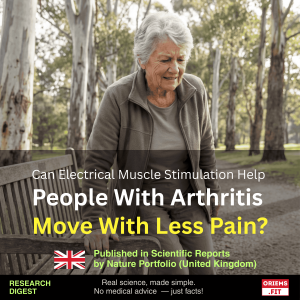
30.7% less knee pain was reported after seven months using electrical muscle stimulation.Could gentle muscle activation really help people with arthritis move with less pain?
That question led researchers to study adults living with painful knee osteoarthritis.They followed 72 people in a randomized trial lasting seven full months.One group used whole-body electrical muscle stimulation for just 20 minutes per session.The other group received standard physiotherapy care commonly used for arthritis.Pain improved 30.7% with EMS, compared to only 12.5% with usual care.Daily pain scores dropped 1.78 points, while the control group dropped just 0.76.Standing from a chair improved by 4.3 repetitions with EMS.The usual care group improved by only 0.53 repetitions.Leg and hip strength increased by 104.9 newtons using EMS.That was more than three times higher than the comparison group.Fewer people still needed pain medication after seven months of EMS.Attendance stayed high at 88%, showing people could stick with this approach.The study was published in Scientific Reports by Nature Portfolio in the United Kingdom.If this surprised you, the full research reveals even more interesting details.Click the link to explore the full research digest, podcast, and original study.👉 https://bit.ly/49D6Wxc

Jan 24, 2026
Jan 24, 2026
37 min
Did you know electrical muscle stimulation reduced knee pain in arthritis patients in just 8 weeks?
So why aren’t more people talking about this simple muscle-activation research?
In a real clinical trial, adults with knee arthritis were carefully followed.
Some used gentle electrical muscle stimulation with simple exercises.
Others only received education and daily activity advice.
After 8 weeks, the results were surprisingly different.
Pain scores dropped significantly in the stimulation group.
Daily activities like standing and walking became easier too.
Function scores improved more than the education-only group.
This wasn’t a lab experiment or marketing test.
It was a peer-reviewed clinical trial published in a medical journal.
The researchers measured pain, movement, and daily living ability.
The key idea was not joints alone.
It was how activating weak thigh muscles supports the knee.
Stronger muscle signals may reduce stress on painful joints.
That raises a big question.
Could muscle activation change how arthritis feels day to day?
This study explored that idea in real people.
With real knees.
And real daily struggles.
If this surprised you, there’s much more inside the full research digest.
Including exact numbers, test methods, and what made this study different.
You’ll also find links to the original research paper.
Plus podcasts and other fascinating science we uncovered.
Like this research digest?
Share it with your friends who care about movement and joints
Read more here https://bit.ly/4q2zepL